We may earn a commission when you buy through links on this page, at no extra cost to you. How this works.
The kitchen is where daily wellness decisions become routine. Water quality and nutrient extraction shape hydration, mineral intake, and the bioavailability of vitamins and phytonutrients in every meal. Smart countertop devices automate filtration and preparation, turning intention into consistency.
Choosing the right tools requires clear criteria. Filtration capacity and flow rate determine how much purified water you can produce without bottlenecks. Motor power and extraction efficiency affect nutrient yield from whole foods - particularly fiber, polyphenols, and fat-soluble vitamins. Countertop footprint matters in real kitchens with limited space, and maintenance frequency dictates long-term usability. Cost per gallon or serving provides the clearest comparison across devices with different lifespans and consumable requirements.
Water filtration addresses chlorine, heavy metals, and particulates that affect taste and mineral balance. Nutrient extractors - blenders, juicers, and cold-press systems - break down cell walls to improve absorption and reduce prep time. Both categories have evolved beyond basic function into smart, compact designs that fit evidence-based nutrition habits.
This guide compares devices on measurable attributes: filter lifespan, contaminant reduction, motor wattage, extraction yield, and total cost of ownership. The goal is to match your hydration volume, food prep style, and kitchen layout to the system that removes friction from daily optimization.
Daily Integration Checklist: Water and Nutrient Optimization
- Filter and store 1-2 gallons of water overnight for next-day hydration baseline
- Pre-portion leafy greens and frozen fruit in containers for faster morning blending
- Track filter lifespan with calendar reminder or usage log to maintain contaminant reduction
- Clean extractor blade and gasket immediately after use to prevent biofilm buildup
- Rotate between room-temperature filtered water and blended nutrients to support digestion rhythm
- Batch-prep smoothie ingredients on rest days to reduce daily decision load
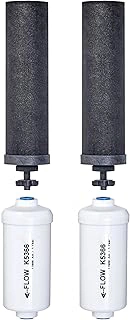
Berkey Black Berkey (BB9-2) & PF-2 Fluoride Reduction Elements Combo (Set of 2)
The Berkey Black Berkey (BB9-2) with PF-2 Fluoride Reduction Elements operates entirely without electricity, relying on gravity to feed untreated water through its filtration media. This combo pairs the stainless steel housing with both standard Black Berkey purification elements and optional PF-2 fluoride filters, giving you dual-stage contaminant reduction in a single countertop unit.
The gravity-fed design means no pressure lines, no installation, and no ongoing power cost. You fill the upper chamber, and filtered water collects in the lower reservoir at a rate determined by the number of filter elements installed. The system accommodates two or four Black Berkey elements depending on your throughput needs; more elements mean faster flow. The included PF-2 filters attach below the Black Berkey elements to target fluoride and arsenic compounds that pass through the primary stage.
Filter longevity is a defining characteristic. Each Black Berkey element is rated for approximately the listed service life before replacement, and the PF-2 fluoride filters handle roughly the listed service life. For a household using two gallons per day, the Black Berkey elements may last over four years, while the fluoride filters require replacement closer to once per year. This extended service interval spreads the replacement cost across thousands of gallons, keeping per-gallon expense low compared to pitcher filters or bottled water.
The tradeoff is physical size and countertop real estate. The Black Berkey model holds approximately the listed size in the lower chamber, and the stainless steel body stands over a foot tall. You'll need stable counter space or a dedicated sideboard. Filtration speed is also passive - expect several hours to process a full upper chamber, not the instant flow of an under-sink or inline system. If you need water on demand, you'll plan ahead and keep the lower chamber stocked.
Maintenance involves periodic cleaning of the elements and chamber, plus eventual replacement of both filter types. The process is straightforward: unscrew the wing nuts, remove spent filters, prime new elements, and reassemble. No proprietary tools or professional service required. The self-contained design also makes the system portable for off-grid use, emergency preparedness, or relocation between homes.
At $379.99, this combo includes both the stainless housing and the initial set of Black Berkey and PF-2 filters. Replacement Black Berkey elements typically cost less per pair than the original housing investment, and PF-2 filters are sold separately when due. The rated 4.5/5 user feedback reflects satisfaction with contaminant reduction breadth and operational simplicity, balanced against the bulk and slower throughput inherent to gravity systems.
This system suits households prioritizing comprehensive filtration without plumbing modification, willing to accommodate the footprint and passive flow rate in exchange for no-power operation and low per-gallon cost over time.
- ✅ No electricity or plumbing required - gravity-fed operation
- ✅ Black Berkey elements rated for approximately 3,000 gallons each
- ✅ PF-2 fluoride filters add targeted reduction for fluoride and arsenic
- ✅ Low per-gallon cost over multi-year filter lifespan
- ✅ Portable and suitable for off-grid or emergency use
- ⚠️ Large countertop footprint - over 12 inches tall
- ⚠️ Passive filtration speed requires planning ahead
- ⚠️ PF-2 fluoride filters need replacement approximately annually
- ⚠️ $379.99 upfront investment for combo system
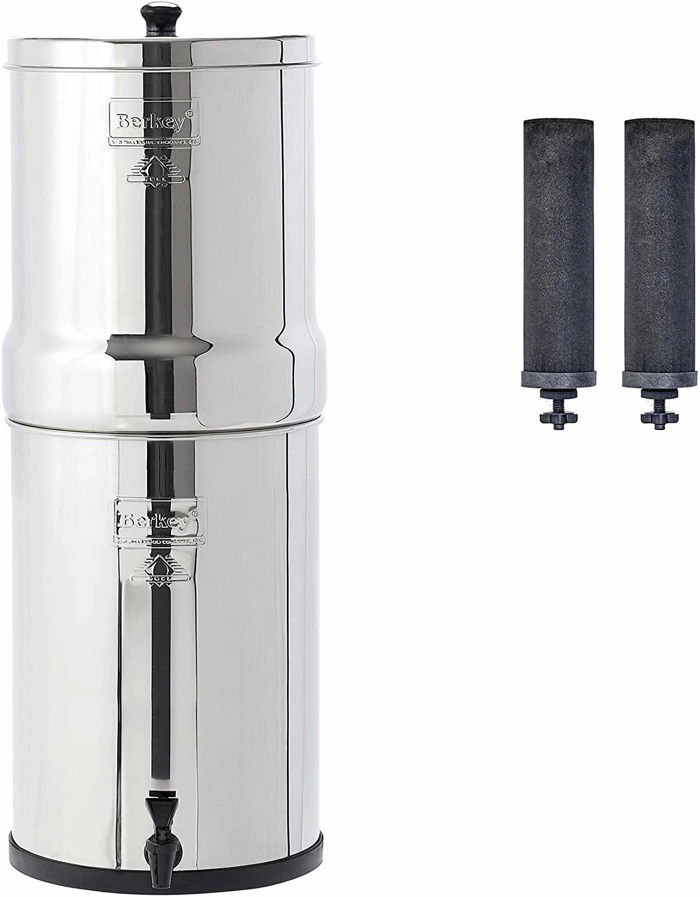
Crown Berkey 6-Gallon Stainless Steel Countertop Filter System with 2 BB9-2 Elements
The Crown Berkey 6-Gallon Stainless Steel Countertop Filter System with 2 BB9-2 Elements is a high-capacity gravity filtration option designed for larger households or users with high daily water consumption. With a 6-gallon reservoir, this system holds significantly more water than smaller countertop models, reducing the frequency of refills when serving multiple people or preparing large batches of filtered water for cooking and drinking.
This stainless steel system operates on gravity filtration principles, using two BB9-2 elements to process water without requiring electricity or plumbing connections. The larger capacity means longer intervals between refills, which can be convenient for families or small offices, though the tradeoff is a taller profile and greater counter footprint compared to compact units. Users should measure available vertical clearance and counter space before purchase, as the height required to stack the upper and lower chambers may not fit under all cabinets.
Flow rate scales with the size of the reservoir - filling the listed size takes longer than smaller systems, but once filled, the volume available supports higher simultaneous use. The stainless steel construction offers durability and a neutral aesthetic that fits most kitchen environments. At $478.00, this system represents a step up in both capacity and price, suited to users who prioritize volume and infrequent refilling over compactness.
Rated 4.6 out of 5, the Crown Berkey delivers reliable gravity filtration for households that need substantial daily filtered water without the complexity of installation or ongoing electricity costs. Consider this model if your household regularly consumes more than the listed size per day or if you prefer to refill less often, and confirm that your counter layout can accommodate its footprint and height.
- ✅ 6-gallon capacity reduces refill frequency for larger households
- ✅ Gravity filtration requires no electricity or plumbing
- ✅ Stainless steel construction offers durability
- ✅ Two BB9-2 elements included
- ⚠️ Taller profile may not fit under all cabinets
- ⚠️ Larger footprint requires more counter space
- ⚠️ Higher price point at $478.00
- ⚠️ Filling 6 gallons takes longer than smaller systems
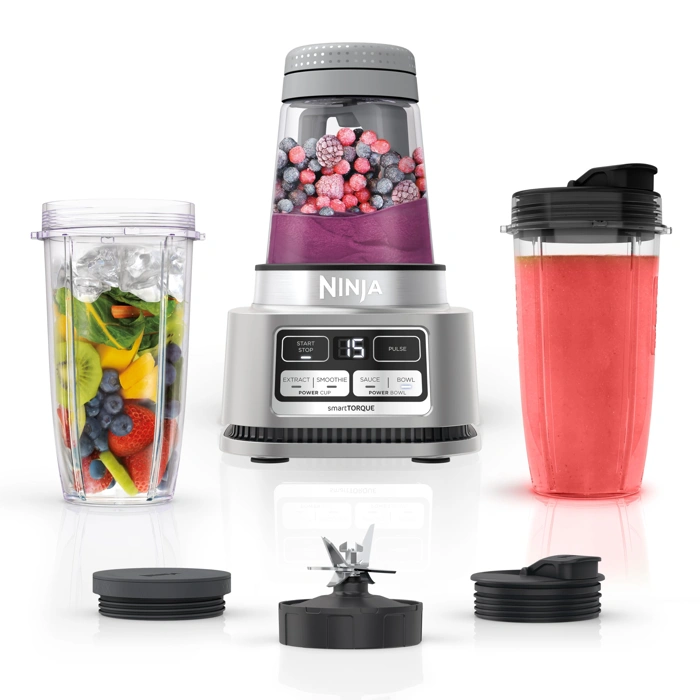
Ninja SS101 Foodi Personal Smoothie Maker, 1200 Peak Watt Motor
The Ninja SS101 Foodi Personal Smoothie Maker delivers 1200 peak watts in a compact footprint designed for single-serve use. The motor handles leafy greens and frozen fruit, turning ingredients into smooth blends without the bulk of a full-size countertop blender.
This model uses a personal-size blending cup that doubles as a travel container, eliminating the need to transfer finished smoothies. The cup capacity suits one serving, making it practical for individuals who blend daily but lack counter or cabinet space for larger appliances.
The 1200-watt motor provides enough torque to break down fibrous greens and ice, though blending time may extend slightly compared to higher-wattage full-size units. For kale, spinach, and frozen berries, the motor maintains consistent speed under load, producing even texture without leaving large chunks.
Cleaning is straightforward: the blending cup and blade assembly separate for hand washing or dishwasher use. The compact base wipes clean quickly, and the single-serve design means fewer parts to manage compared to multi-jar systems.
The trade-off is capacity. If you regularly prepare smoothies for multiple people or prefer batch-blending for meal prep, a larger blender will be more efficient. For solo use or households where only one person blends routinely, the space savings and simplified workflow offer clear advantages.
At $99.99, the Ninja SS101 sits below premium full-size blenders but above basic personal models with lower wattage. The motor performance justifies the price for users who prioritize blending power in a small form factor.
- ✅ 1200 peak watts in compact design
- ✅ Blending cup doubles as travel container
- ✅ Handles leafy greens and frozen ingredients
- ✅ Simple two-part cleaning process
- ✅ Space-efficient for single-serve use
- ⚠️ Single-serve capacity limits batch preparation
- ⚠️ Blending time may be longer than full-size high-wattage units
- ⚠️ Not suitable for multi-person households
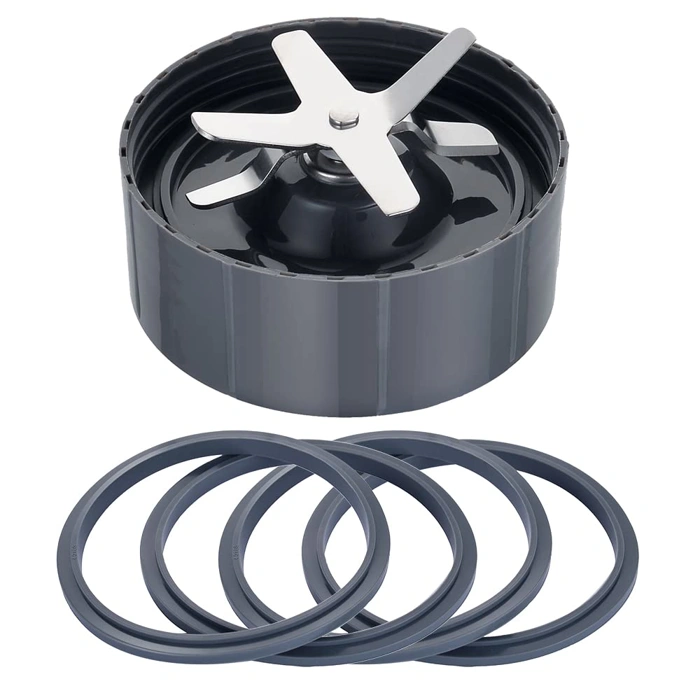
Nutribullet Replacement Extractor Blade & 4 Gaskets (5 Pcs) for 600W/900W Blenders
Blade sharpness and gasket integrity directly affect extraction efficiency in Nutribullet 600W and 900W blenders. This 5-piece replacement set includes one extractor blade and four gaskets, addressing the two most common wear points in these systems.
Blades dull over time with regular use, particularly when processing fibrous vegetables, frozen fruit, and hard seeds. Reduced sharpness increases blending time and leaves larger particle sizes in the final blend, which can affect nutrient availability and texture. Gaskets compress and crack with heat cycles and repeated assembly, leading to leaks and reduced suction during extraction.
This replacement set is designed for compatibility with Nutribullet 600W and 900W models. The four included gaskets provide multiple replacements, useful if you cycle through them to extend lifespan or if you maintain multiple blending cups. At $12.99, the set costs less than a single original equipment blade assembly from the manufacturer.
Check your Nutribullet model number before purchasing. The extractor blade design differs between the 600W/900W series and newer Pro models. If your gaskets show visible cracks, have lost elasticity, or if you notice liquid seeping during blending, replacement is warranted. Similarly, if blending times have increased noticeably or you see unprocessed chunks that previously blended smoothly, blade replacement may restore performance.
The set ships as a third-party compatible product rather than an OEM part. Fit and material quality can vary with aftermarket components, so inspect the blade threading and gasket dimensions upon arrival to confirm proper seating in your cups and base.
- ✅ Includes four gaskets for multiple replacements
- ✅ Compatible with both 600W and 900W Nutribullet models
- ✅ Lower cost than OEM blade assemblies
- ⚠️ Third-party product with potential fit variation
- ⚠️ Not compatible with Nutribullet Pro models
- ⚠️ Material quality may differ from original equipment
What to Look For in a Countertop Water Filtration System
Choosing a countertop water filtration system requires balancing performance, convenience, and your specific water quality concerns. Unlike under-sink or whole-house systems, countertop units offer plug-and-play simplicity, but the right choice depends on understanding several core tradeoffs.
Start with the contaminant reduction spectrum. Most countertop filters target chlorine and sediment, improving taste and clarity. If your municipal report flags fluoride, heavy metals like lead or mercury, or volatile organic compounds (VOCs), verify that the system's media - whether activated carbon, ion exchange resin, or ceramic - addresses those specific contaminants. Generic "multi-stage" claims matter less than certified reduction percentages for the pollutants in your water.
Next, consider the flow rate versus reservoir capacity tradeoff. Gravity-fed models with upper and lower chambers offer larger batch volumes - often two to three gallons - but filtration takes time, sometimes an hour or more per fill. Pressurized or inline countertop units deliver faster on-demand flow, yet they typically lack significant storage, meaning you draw filtered water one glass at a time. Think about whether you fill pitchers and bottles in advance or prefer instant access during meal prep.
Filter lifespan and replacement cost form the long-term economics. A system with a low upfront price but proprietary cartridges that need swapping every two months can cost more annually than a unit with six- or twelve-month filter life. Calculate the per-gallon cost over a year, factoring in your household's daily consumption, to understand the true expense.
Countertop space is a practical constraint. Gravity systems with stacked chambers stand tall and occupy a footprint roughly the size of a large coffee maker. Compact pressurized units or faucet-diverter styles take less vertical space but may require a dedicated spot near the sink and a hose connection. Measure your counter layout and consider whether the unit will interfere with cabinet doors, appliances, or daily workflow.
Finally, assess installation complexity - or the lack of it. True countertop systems should not require plumbing modifications. Gravity models need only assembly and an initial rinse. Pressurized units may use a temporary diverter valve on your existing faucet, which you install by hand in minutes. If a product requires drilling, permanent fixtures, or a plumber's visit, it has crossed into a different category and may not suit renters or those seeking portability.
By weighing contaminant priorities, flow preferences, filter economics, spatial constraints, and installation ease, you can identify which countertop filtration approach fits both your water quality goals and your kitchen reality.
Nutrient Extraction vs. Juicing: What Matters for Bioavailability
Nutrient extraction and juicing represent two distinct approaches to incorporating fruits and vegetables into your diet, each with different implications for how your body processes nutrients. Understanding these differences helps you choose the right tool for your wellness goals.
Nutrient extraction - sometimes called whole-food blending - pulverizes entire fruits and vegetables, including skin, seeds, and pulp, breaking down cell walls to make nutrients more accessible while retaining all the fiber. High-powered blenders designed for extraction typically operate at 20,000 to 30,000 RPM with blade systems engineered to create vortex action that repeatedly cycles ingredients through the cutting zone. This mechanical process ruptures plant cell walls, releasing vitamins, minerals, and phytonutrients that would otherwise remain locked inside fibrous structures during chewing and digestion.
Juicing, by contrast, separates liquid from fiber through pressing or centrifugal force, producing a concentrated source of vitamins and minerals without the insoluble fiber. This creates a beverage that's absorbed more quickly, but also one that can trigger a faster glycemic response when made from high-sugar fruits. The absence of fiber means nutrients enter your bloodstream more rapidly, which may be desirable in some contexts but can lead to blood sugar spikes and reduced satiety compared to fiber-rich whole-food smoothies.
Motor power and blade design directly influence extraction efficiency. Blenders with motors rated above 1,000 watts and multi-tiered blade assemblies tend to achieve more thorough cell-wall breakdown in less time. Blending duration also matters: most high-performance blenders achieve optimal nutrient extraction in 45 to 90 seconds, with diminishing returns beyond that point as excessive blending can generate heat that may degrade heat-sensitive vitamins like vitamin C and some B vitamins.
Fiber retention in nutrient extraction offers several functional advantages. Soluble fiber slows glucose absorption, moderating blood sugar response and helping maintain steady energy levels. Insoluble fiber adds bulk that promotes satiety and supports digestive transit. When you consume a whole-food smoothie, you're receiving the complete nutritional package - not just isolated nutrients, but the synergistic combination of vitamins, minerals, antioxidants, and fiber as they exist in nature.
The choice between extraction and juicing depends on your specific needs. If you're looking to increase vegetable intake while managing blood sugar and maintaining fullness between meals, nutrient extraction preserves the fiber that supports those goals. If rapid nutrient delivery is your priority - for example, consuming concentrated micronutrients immediately after intense physical activity - juicing may better serve that purpose. Neither approach is universally superior; each represents a different set of tradeoffs in nutrient delivery, digestion speed, and functional outcomes.
Building Your Optimized Wellness Kitchen: Tradeoffs and Next Steps
Choosing the right combination of water filtration and nutrient systems depends on your kitchen footprint, budget, and daily routine. Gravity filters offer simplicity - no electricity, quiet operation, and portability - but require manual refilling and deliver slower flow rates, typically 0.5 - 1.5 gallons per hour. Countertop reverse-osmosis units process water faster and remove a broader spectrum of contaminants, yet they need a power outlet, produce wastewater, and occupy more counter or under-sink space.
For nutrient extraction, high-wattage personal blenders (600 - 1,200 watts) excel at single-serve convenience and quick cleanup but lack the capacity for meal prep or batch recipes. Full-size blenders and cold-press juicers handle larger volumes and tougher ingredients, though they demand more counter real estate and involve disassembling multiple parts for cleaning.
Budget planning often helps prioritize acquisition. Entry-level gravity filters start around $35 - $50, while countertop RO systems typically begin near $200 - $400. Personal blenders range from $40 to $150; premium full-size models and masticating juicers can reach $300 - $500. If clean water is your immediate goal, start with the best countertop water filter that fits your space and flow requirements, then add a nutrient device as your routine solidifies.
Complementary tools can support your setup without requiring major investment. Inexpensive pH test strips verify filtration effectiveness and track water quality over time. Nutrient timing trackers - whether paper logs or mobile apps - help align smoothie and juice intake with your activity schedule. Storage containers that preserve freshness extend the usability of batch-blended or juiced nutrients, reducing waste and simplifying weekday routines.
A phased approach spreads cost and learning. Install a water filter first to establish a clean hydration baseline, then evaluate whether a personal blender meets your portion needs or whether a full-size system justifies the counter footprint. As you refine preferences, you'll recognize which features - filter speed, blender motor torque, ease of cleaning - matter most in your daily flow, making future upgrades more deliberate and aligned with real-world use.