We may earn a commission when you buy through links on this page, at no extra cost to you. How this works.
Smart rings and smart watches each promise to deliver biometric data for health tracking and this product, but their accuracy depends on sensor placement, measurement methodology, and the specific metric you prioritize. A smart ring worn on the finger sits closer to arterial blood flow, which can improve certain readings like heart rate variability and body temperature. A smart watch worn on the wrist offers a larger sensor array and more real estate for optics, accelerometers, and processing power, but wrist movement and fit variability can introduce noise.
Accuracy varies by metric type. For continuous heart rate monitoring during activity, wrist-based optical sensors in smart watches typically perform better because they average data across a larger contact area and benefit from motion-correction algorithms. For overnight heart rate variability and resting metrics, finger-based sensors in smart rings often show tighter alignment with medical-grade references because the finger has less motion, thinner skin, and stronger pulse signals during sleep.
Comfort for continuous wear matters when consistency drives data quality. A ring stays in place without bands that loosen or shift, making it less obtrusive for 24/7 tracking. A watch offers a screen for real-time feedback and broader app ecosystems, but some users remove it at night or during certain activities, which creates gaps in the data set.
Battery life shapes how often you need to remove the device for charging. Most smart rings last three to seven days per charge, while most smart watches require daily or every-other-day charging. Longer battery life reduces interruptions in continuous tracking, which is especially relevant for sleep and recovery metrics that depend on unbroken wear.
Ecosystem integration and actionable insight delivery determine whether raw accuracy translates into useful decisions. Some platforms excel at trend analysis and readiness scores, while others provide granular data exports for advanced users. The right device depends on whether you need a dashboard that interprets data for you or raw numbers you can analyze independently.
This guide compares smart rings and smart watches across accuracy by biometric type, wear comfort and compliance, battery endurance, and the quality of insights each platform delivers. Use these criteria to match device strengths to your specific this product goals.
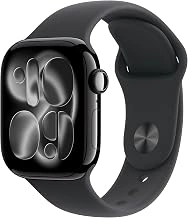
Apple Watch Series 11 GPS 42mm Smartwatch, Jet Black Aluminum, Black Sport Band
The Apple Watch Series 11 delivers continuous heart rate monitoring, sleep stage tracking through native watchOS features, and a wide range of activity metrics that make it a strong candidate for Apple Watch Series 11 GPS 42mm Smartwatch, Jet Black Aluminum, Black Sport Band who want real-time feedback throughout the day. The 42mm case fits most wrists comfortably, and the black sport band stays secure during workouts without feeling restrictive.
Heart rate data updates frequently, giving you instant visibility into resting heart rate trends and workout intensity zones. Sleep tracking captures time asleep and sleep stages, though the device needs to be charged daily, which means you'll need to plan a charging window - typically during your morning routine or while working at a desk - to maintain overnight data collection. Battery life lasts about a day with moderate use, so this is a trade you accept in exchange for the always-on display and continuous sensor activity.
The ecosystem advantage is significant. Third-party apps for HRV analysis, glucose tracking integrations, and detailed workout Apple Watch Series 11 GPS 42mm Smartwatch, Jet Black Aluminum, Black Sport Band extend the watch's utility well beyond Apple's native Health app. If you already use an iPhone and want a single device that handles notifications, calls, timers, and biometric logging without carrying multiple gadgets, the Series 11 consolidates those roles effectively.
At $329.00, this model sits at a higher price point than many dedicated sleep and recovery trackers, but it offers broader day-to-day functionality. The watch works best for users who value multi-function utility - checking messages, controlling music, tracking runs, and reviewing heart rate variability - all from the wrist. If your priority is passive overnight tracking with minimal charging interruption, a ring-style tracker may suit your routine better. But if you want an active dashboard that syncs with a wide app library and supports both workout intensity and recovery metrics, the Apple Watch Series 11 provides that breadth in a familiar, well-supported platform.
- ✅ Continuous heart rate monitoring with frequent updates
- ✅ Native sleep stage tracking and broad third-party app support
- ✅ Tight integration with iPhone and Health app ecosystem
- ✅ Comfortable 42mm case and secure sport band for all-day wear
- ⚠️ Requires daily charging, limiting uninterrupted overnight tracking
- ⚠️ Higher price point compared to dedicated recovery wearables
What is a Smart Ring? Core Technology and Sensor Advantages
A smart ring is a lightweight wearable that fits on your finger and uses optical sensors to track biometric data through the digital arteries running close to the skin. Because fingers have rich blood flow and minimal movement during sleep, rings can capture stable pulse waveforms that translate into metrics like heart rate variability, blood oxygen saturation, resting heart rate, and body temperature trends.
Most smart rings focus on passive, continuous tracking rather than real-time alerts or workout modes. They log sleep stages by measuring heart rate patterns, movement, and temperature shifts throughout the night, then present the analysis each morning. HRV readings benefit from the stable contact and reduced motion artifact compared to a wrist placement, where ligaments and tendons can introduce noise into the optical signal.
The absence of a screen means no notifications, no tap interactions, and no reason to remove the ring during the day. This design appeals to users who want recovery and readiness data without the this product pull of a smartwatch. Leading models like the Oura Ring and Ultrahuman Ring Air have popularized the category by pairing lightweight hardware with algorithms tuned for sleep and autonomic nervous system tracking.
Body temperature monitoring on the finger also offers an advantage: the ring sits farther from large muscle groups and closer to peripheral circulation, so it can detect small deviations that correlate with illness, menstrual cycle phases, or overtraining. Because the sensor array remains in constant contact without wrist flexion, temperature baselines tend to be more consistent night to night.
Smart rings typically charge once every few days rather than nightly, and their compact profile makes them easy to wear during activities where a watch feels bulky or risky. For this product prioritizing sleep optimization, strain management, and longitudinal trends over step counts and notifications, the ring form factor trades real-time feedback for sensor stability and uninterrupted wear.
What is a Smart Watch? Core Technology and Sensor Advantages
A smart watch is a wrist-worn device that uses multiple optical and motion sensors to track biometric and activity data throughout the day. Most models position a photoplethysmography (PPG) sensor array directly against the underside of the wrist, where it shines LED light through the skin to measure blood flow and calculate heart rate. An accelerometer and gyroscope capture movement in three dimensions, enabling step counts, workout detection, and fall alerts, while GPS modules in higher-end models track outdoor routes and pace without a phone.
Smart watches excel at delivering real-time feedback. You can glance at your wrist mid-run to see your current heart rate zone, check a live ECG reading when you feel an irregular rhythm, or monitor blood oxygen saturation during a high-altitude hike. That immediacy makes them well-suited for interval training, guided breathing sessions, and any situation where you need data in the moment rather than after the fact.
The wrist location offers a larger surface area for sensor contact compared to a finger, which can improve signal stability during movement. However, wrist placement also introduces challenges: looser fit, arm position, and wrist flexion during exercise can all shift the sensor away from consistent skin contact, leading to dropout or noise in the heart rate signal. Cold weather, tattoos, and low peripheral circulation can further interfere with optical readings at the wrist.
Beyond this product, smart watches serve as notification hubs, music controllers, and payment terminals. Category leaders such as the Apple Watch and Garmin's fitness-focused lines integrate deeply with smartphone ecosystems and third-party apps, letting you log meals, sync with training platforms, and export data to analysis tools. That app ecosystem is a significant advantage if you want to layer coaching software, nutrition tracking, or advanced HRV analysis on top of raw sensor data.
Smart watches also offer a broader menu of sensors. Many flagship models now include electrical heart sensors for ECG capture, red and infrared LEDs for blood oxygen estimation, and skin temperature sensors for cycle tracking or fever detection. The larger battery and case size accommodate more hardware, though that same bulk can make 24/7 wear less comfortable during sleep - a tradeoff that matters when sleep data is a this product priority.
The result is a device optimized for active use and real-time interaction, with strong daytime heart rate accuracy during steady-state activity but more variability during high-intensity intervals or sleep. If your this product goals center on workout performance, guided training zones, and app-driven feedback loops, the smart watch's real-time display and multi-sensor array deliver clear value.
Sleep Tracking Accuracy: Finger-Based vs. Wrist-Based Sensors
Finger-based sensors in smart rings measure arterial pulse and skin temperature from the palmar digital arteries, which remain stable during sleep because your hands spend most of the night motionless. This placement reduces motion artifact - the noise created when accelerometers mistake arm movement for wakefulness - and delivers cleaner heart rate variability signals for distinguishing light, deep, and REM sleep stages.
Wrist-based watches combine optical heart rate sensors, accelerometers, and sometimes SpO2 monitors to infer sleep architecture. The wrist location captures more movement data, which helps flag when you get out of bed or roll over, but the same motion can interfere with pulse readings. Studies comparing consumer wearables to polysomnography - the clinical gold standard using brain-wave electrodes - show that finger-worn devices often agree more closely on total sleep time and deep-sleep duration, while wrist devices tend to overestimate light sleep and underreport wake periods.
Temperature sensing highlights another divide. Rings track continuous skin temperature shifts across the night, and even a half-degree change can signal the transition into deeper sleep or the start of a fever. Watches typically sample wrist temperature less frequently, and the wrist's exposure to blankets or room air introduces more variability. For tracking menstrual cycles or early illness, the finger's stable vascular bed offers a clearer baseline.
Heart rate variability during sleep is a core this product metric. The finger's strong pulse signal lets rings calculate inter-beat intervals with less interpolation, producing HRV numbers that align better with chest-strap monitors. Watches improve accuracy when the wrist stays still, but any repositioning - especially during REM when muscle tone drops and you shift positions - can inject gaps that algorithms must fill with estimates.
Rings excel when your priority is passive overnight data: you wear it to bed, and the next morning you see sleep stages, temperature curves, and HRV trends without thinking about it. Watches add context by logging evening workouts, caffeine intake via manual entry, or guided breathing sessions before bed, then correlating that activity data with your sleep graph. If you want a complete timeline from dinner through wake-up, the watch's accelerometer and GPS paint a fuller picture, even if individual sleep-stage timestamps carry wider confidence intervals.
Neither device replaces a sleep lab. Rings may call a restless period light sleep when polysomnography would mark brief awakenings, and watches sometimes label quiet wakefulness as sleep if you lie very still. For relative trends - comparing Tuesday's recovery to Wednesday's after a hard training day - both form factors work. For absolute validation of REM percentage or apnea events, clinical equipment remains necessary.
Choose a ring if you value unobtrusive overnight tracking, stable temperature readings, and HRV precision without charging every other night. Pick a watch if you want sleep data integrated with daytime activity, on-wrist alarms, and the ability to spot patterns between evening exercise intensity and sleep quality in a single dashboard.
Heart Rate Variability and Recovery Metrics: Precision and Context
Heart rate variability measures the time intervals between heartbeats, and even small changes in sensor placement or motion can alter the data significantly. Smart rings track HRV primarily during sleep, when your finger remains still and blood flow patterns are stable. This positioning reduces motion artifact - the interference caused by arm swings, muscle contractions, or wrist flexion - that can corrupt beat-to-beat timing measurements. Watches sample HRV throughout the day and night, capturing readings during workouts, meetings, and rest periods, but wrist motion introduces variability that algorithms must filter or discard.
Sampling rate matters when calculating recovery and readiness scores. Rings typically record HRV at multi-hour intervals during deep sleep, when parasympathetic tone is highest and the signal cleanest. Watches often measure HRV every few minutes or continuously during designated rest windows, giving a broader picture of autonomic nervous system shifts across different states. Neither approach is inherently superior: rings excel at overnight precision for long-term trend tracking, while watches provide context around acute stressors like caffeine, meetings, or interval training.
Recovery algorithms combine HRV with resting heart rate, sleep duration, and sometimes body temperature or respiratory rate. A ring's stable overnight HRV baseline feeds readiness scores that reflect cumulative fatigue and adaptation over days or weeks. Watch-based systems can layer daytime HRV drops - triggered by dehydration, stress, or overtraining - onto morning baselines, offering intraday feedback for pacing decisions. If you adjust training load or nutrition based on daily readiness, the watch's frequent sampling may help you spot acute dips before they compound. If you track week-over-week recovery trends and prefer undisturbed nighttime data, the ring's approach reduces noise.
Neither device replaces medical-grade electrocardiogram equipment, which uses chest electrodes and clinical-grade amplifiers to detect arrhythmias or conduct formal HRV diagnostics. Consumer wearables rely on photoplethysmography - optical sensors that measure blood volume changes - rather than electrical heart signals. This method works well for trend analysis but lacks the millisecond precision needed for clinical interpretation. Consistency in wear time and placement will improve the usefulness of either device far more than chasing marginal sensor advantages.
Training load guidance depends on how you structure workouts and rest days. If you follow periodized programs with hard/easy cycles, a ring's morning readiness score can confirm when accumulated fatigue justifies a recovery day. If you run high-intensity intervals or test new nutrition protocols, a watch that tracks HRV dips within hours of the stressor offers immediate feedback for same-day adjustments. Both devices benefit from at least two weeks of baseline wear before their algorithms accurately reflect your individual patterns.
Body Temperature, SpO2, and Emerging Metrics: Coverage and Limitations
Body temperature tracking differs significantly between rings and watches in both sensor placement and data interpretation. Rings measure temperature from the finger's palmar surface, which experiences less ambient exposure and fewer muscle-generated heat fluctuations than the wrist. This positioning allows rings to capture baseline temperature trends with less environmental noise, making them useful for tracking cycle phases, early illness signals, or recovery patterns. Watches measure skin temperature at the wrist, where blood flow variability, wrist flexion, and ambient temperature create more signal interference throughout the day.
SpO2 sensors in both device types rely on the same optical principle: red and infrared light absorption through capillary beds. Finger placement in rings can reduce motion artifact during sleep measurements, since hands typically remain stiller than wrists during rest. Watches offer on-demand SpO2 spot checks during the day, but continuous overnight monitoring consumes substantial battery - often 10 to 20 percent per night on many models. Rings that track SpO2 continuously integrate the measurement into their existing sensor cadence with smaller incremental battery impact.
Neither device measures core body temperature. Skin temperature serves as a proxy that shifts with room temperature, bedding, clothing, and vasodilation. A 0.5°C skin temperature change does not equal a 0.5°C core change. Both form factors track relative trends rather than absolute clinical-grade readings. Similarly, wearable SpO2 is not a replacement for medical pulse oximetry. Accuracy degrades with poor fit, darker skin tones, cold fingers, and movement. Expect wearable SpO2 to fall within ±2 to 4 percentage points of clinical readings under ideal conditions, with wider variance during activity or poor contact.
Emerging metrics such as skin conductance, respiratory rate derived from movement or heart rate variability, and blood pressure estimation appear sporadically across both categories. These features remain experimental, with limited validation and high sensitivity to wear position and calibration. Treat them as directional signals rather than diagnostic measurements, and prioritize devices that transparently document their sensor methodology and validation scope.
Activity Tracking and Exercise Accuracy: Where Watches Pull Ahead
Smart watches have a clear advantage when you need real-time feedback during workouts. Built-in GPS tracks outdoor runs and rides without carrying your phone, and workout modes adjust heart rate zones on the fly as you move through intervals or hill climbs. The screen displays pace, distance, and current heart rate, which helps you adjust intensity mid-session rather than waiting for post-workout summaries.
Smart rings record daily step counts and general activity totals, but without a display or GPS chip, they cannot guide you through a training session. You wear the ring passively, then review movement patterns and recovery metrics later in the companion app. This works well for tracking overall activity trends and identifying rest-day needs, but it leaves you without the immediate data that structured training requires.
Calorie burn estimates remain similarly imprecise on both devices. Watches and rings use heart rate, motion sensors, and user profile data - age, weight, height - to model energy expenditure, and research shows error margins often land between 15 and 30 percent for both form factors. Neither device directly measures oxygen consumption, so treat calorie numbers as rough guides rather than exact totals.
Choose a smart watch if you follow training plans, need pace alerts, or want to see heart rate zones during exercise. A ring suits you better if you care more about recovery signals, sleep architecture, and daily movement baselines than live workout metrics. The difference comes down to whether you need a coach on your wrist or a passive logger on your finger.
Form Factor, Comfort, and Battery Life: Practical Wear Considerations
Wearing a sensor continuously for weeks or months changes how you think about device design. A smart ring sits on your finger with minimal surface area, typically weighing between 2 and 6 grams, which makes it easy to forget during sleep, workouts, or formal occasions. Most rings deliver four to seven days of battery life per charge, so you can collect uninterrupted data across multiple sleep cycles without daily charging rituals. That passive approach works well when your priority is longitudinal tracking rather than real-time alerts.
Smart watches occupy more wrist real estate and weigh anywhere from 30 to 60 grams depending on case material and screen size. The larger battery supports a color display, haptic feedback, and notification mirroring, but you'll need to charge every one to three days - sometimes nightly if you enable always-on display and GPS. Taking the watch off to charge interrupts sleep tracking unless you plan a charging window during your morning routine. Bulk also matters during sleep: a watch case and band can press against your hand or catch on bedding, while a ring stays out of the way.
Sizing introduces a different set of tradeoffs. Ring fit must be precise - too loose and the optical sensors lose contact; too tight and you risk discomfort or restricted circulation. Many manufacturers ship sizing kits, but finger dimensions change with temperature, hydration, and activity, so a ring that fits perfectly at rest may feel snug after a workout. Watches use adjustable bands with multiple hole positions or link removals, making it straightforward to dial in tension for different wrist sizes or daily swelling.
Durability specs tend to converge: both form factors commonly offer water resistance rated to 50 or 100 meters and use materials like titanium, ceramic, or hardened glass to resist scratches. Rings have fewer exposed components and no screen to crack, but they sit closer to hard surfaces during daily tasks. Watches benefit from screen protectors and raised bezels, though the display remains a vulnerable point. If you work with your hands frequently, a ring may withstand incidental impacts better than a watch face.
The clearest tradeoff is between invisible data collection and interactive functionality. A ring sacrifices buttons, screens, and notifications to become a set-and-forget sensor; a watch trades some comfort and charging convenience for the ability to glance at metrics, respond to alerts, and control music or timers. Choose based on whether you want the device to disappear into your routine or serve as an active dashboard throughout the day.
Ecosystem, Apps, and Actionable Insights: Turning Data Into Decisions
Raw biometric data means little without software that translates numbers into decisions. Smart rings center their approach on simplicity: a single readiness score each morning, recovery guidance, and minimal interruptions throughout the day. Oura's app synthesizes sleep stages, heart rate variability, and body temperature into a 0 - 100 score that tells you whether to train hard or rest. The tradeoff is a required monthly membership for full access to trends, insights, and personalized recommendations. Ring platforms typically offer limited third-party integration, though some support data export to Apple Health or Google Fit for users who want a unified dashboard.
Smart watches deliver expansive app ecosystems and real-time notifications. Apple Watch integrates natively with the Health app at no subscription cost, pulling data from dozens of sources and pushing activity rings, stand reminders, and irregular rhythm alerts throughout the day. Fitness platforms like Strava, TrainingPeaks, and MyFitnessPal sync seamlessly, letting you overlay workout data with nutrition logs or training plans. Garmin and other watch makers offer API access for power users who want to pipe biometric streams into custom dashboards or research tools. The breadth of choice means more configuration work upfront, and the constant stream of notifications can conflict with the mindfulness that many this product seek. If you value a single morning check-in and hands-off tracking, ring software keeps decision fatigue low. If you need granular workout metrics, cross-platform syncing, and the flexibility to layer in new apps as your routine evolves, a watch ecosystem supports that complexity without gating core insights behind a paywall.
Choosing the Right Wearable: Decision Framework
- Choose a smart ring if overnight recovery, HRV trends, and body temperature tracking are your primary biohacking metrics
- Choose a smart watch if you need real-time workout feedback, GPS tracking, broad app integration, and on-wrist notifications
- Prioritize finger-based sensors for more stable sleep and temperature data with fewer motion artifacts
- Prioritize wrist-based sensors for comprehensive activity tracking, exercise modes, and on-wrist notifications
- Consider battery life requirements: rings last 4 - 7 days; watches require daily or every-other-day charging
- Evaluate ecosystem lock-in: some rings require ongoing subscriptions; watch platforms may tie you to specific app stores
Conclusion: Matching Wearable Technology to Your Health Priorities
Neither smart rings nor smart watches hold a universal accuracy advantage across all biometric data. The more accurate device depends entirely on which metrics matter most to your this product goals and how you prefer to collect data throughout the day.
Smart rings deliver their strongest performance during passive, overnight monitoring. Sleep architecture, heart rate variability measured in recovery windows, and skin temperature trends are captured with minimal interference because the ring remains stationary and unobtrusive. If your this product routine prioritizes recovery signals, circadian rhythm insights, and long-term readiness patterns without disrupting daily habits, a ring offers compelling accuracy in those specific domains.
Smart watches excel when real-time feedback and activity context drive your decisions. They provide continuous workout heart rate tracking, GPS-validated distance and pace data, and immediate on-screen guidance during training sessions. Their larger sensor arrays and processing power support broader app ecosystems and granular performance metrics. If active training optimization, intraday movement goals, and interactive coaching shape your this product approach, a watch delivers the accuracy and immediacy those use cases demand.
Start by identifying whether recovery monitoring or active performance tracking forms the core of your routine. Choose the device that aligns with that primary need, knowing each category brings specific strengths rather than across-the-board superiority. Budget and curiosity permitting, layering both devices later can capture complementary data streams without redundancy, since their measurement windows and strengths rarely overlap completely.